









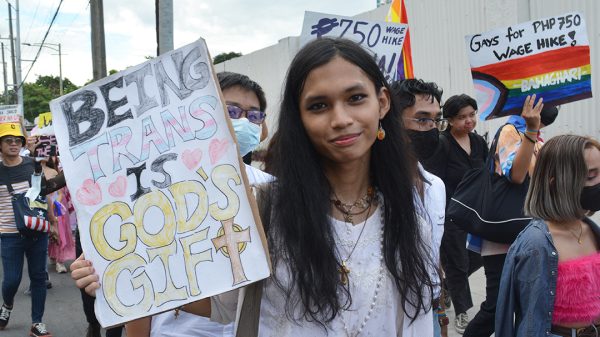

















Non-affirming religious doctrine may engender internalized homophobia or transphobia among LGBTQIA+ people of faith, undermining the positive mental health outcomes otherwise associated with religiosity and spirituality.
This is according to a study, “Called by Name: A Systematic Review of the Quantitative Literature on the Relationship Between Religiosity/Spirituality and Mental Health for LGBTQIA+ People-of-Faith” by Kevin Prada, Naomie Lemyre and Bassam Khoury, that was published in the Journal of Homosexuality.
“There was a lot of diversity in what we found, but across all papers, internalized homo/bi/transphobia, an experience borne out of non-affirming religious doctrine, led to a slew of serious mental health outcomes, even unto substance use and suicide,” said Kevin Prada, lead author of the study, which synthesized the findings of 55 quantitative studies on the subject, representing over 500,000 respondents worldwide.
When LGBTQIA+ people receive non-affirming religious messages, they might engage in self-hate in order to be accepted and loved by a divine power and to belong in a community, Prada said.
Faith and mental health
Prada noted that generally, in the literature, religiosity and spirituality are positively associated with mental health, except for LGBTQIA+ individuals, where the situation is more mixed.
Spirituality can be understood as the internal connection a person holds in a higher power or to something greater than oneself. Religiosity, by contrast, is generally understood as more observable behaviours or expressions of belief, such as attending church or participating in rituals.
“When we look at spirituality and religiosity as something connecting us to something that’s bigger than who we are, we can understand how that can give us a sense of purpose, a sense of meaning in life, as well as a really strong sense of belonging and community, which are all factors that we know are highly beneficial for people’s mental health,” said Prada.
“There are reasons why some queer people choose to stay even within non-affirming religions,” he added. “And there’s also this theme we see of many LGBTQIA+ people around the globe leaving or even transforming, “queering” different non-affirming religious contexts into something that’s actually more suited and more consistent, more congruent with who they are.”
Mindfulness as an alternative path
The review also highlights how mindfulness can be a way that LGBTQIA+ people stepping away from a non-affirming religious group can fill the void and obtain the protective effects of spirituality.
Prada, who is part of the McGill Mindfulness Research Lab led by Khoury, a co-author of the study, explained that he hopes to develop a mindfulness-based intervention as part of his larger research work.
A complementary qualitative research review is also in the works, he said, which will aim to better explain the findings of this study and include larger samples of Two Spirit individuals and others whose experiences have not sufficiently been captured by quantitative research.