















By Skylar Lyralen Kaye
In my Bachelorx-just-out-of-a-marriage adventure, the new woman and I walk toward each other down a hilly sidewalk next to a long stretch of beach. Cell phones held to our ears, we search, me waving a blue-sleeved arm in the air.
“Do you see me?” I ask.
“I see a woman waving her arm on a bridge,” the new date answers.
Oh no.
“Not a woman,” I say into the phone.
“Fuck,” she says when I walk up. “I fucked up first thing. I was so worried I would fuck it up and I fucked it up. I’ll probably fuck up again.”
“It’s a learning curve,” I say, but my heart sinks down past my stomach onto the cold February asphalt.
Of the many—count them, over ten in less than a year—lesbian women over 50 I dated, all screwed up my pronouns and then went into shame spirals afterwards.
Or pretended they didn’t notice their own mistake.
Or genuinely didn’t notice.
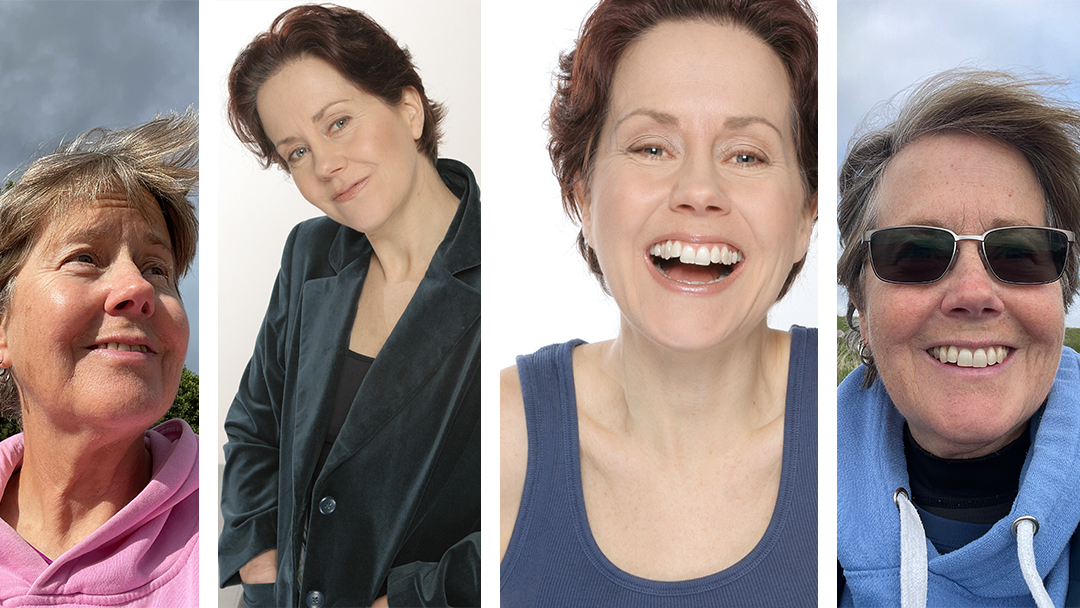
Dating after a 35-year marriage, new to the apps, deep inside a newly out experience of trans euphoria and joy, I discovered so much! The fun: being boi in response to women flirting, initiating dates (which I’d never done), sexting, initiating touch and sex—being a top for the first time! Beach dates, theater dates, weekends away, film dates, meeting families and friends. TEXTING! And more TEXTING! At all times of day including while they’re at work still messaging away.
I really hate the texting. The women said what they couldn’t in person on the small screen, including “I love you.”
Then two women I dated requested I stop talking to my friends about what was happening in our relationship. One wanted me to end a friendship with someone she was convinced was attracted to me. This was accompanied by declarations of love and invitations to move in, all before a month went by.
Of course, some women, in contrast, offered an unwillingness to do anything but message on the apps. Even the avoidants texted all the time!
Regardless of which side of the urge-to-merge/avoid-and-string-along divide women leaned toward three things tended to be true:
- They had never known a nonbinary person their own age
- They had been on and off the apps/meetups/singles groups for decades, chasing the dream of their person but never finding her
- They had all been to therapy and read countless self help books
Dating late middle-aged lesbians means dating either women just out of a long marriage or, 90% of the time, dating the women who were never able to build such a marriage. The majority regaled me with stories of crazy ex after crazy ex, then wistfully sighed and said they didn’t know why marriage never happened. Were lesbians just crazy, some of them wondered. Or perhaps they had a bad picker, as they always ended up with an alcoholic or a narcissist.
Which is, of course, human comedy at its finest — the “it’s never my fault” pageantry of dating.
The longing is real, though. Painfully, terribly real. So much so that the unknown identity of a sixty-something non-binary person becomes attractive, even if you’ve only dated cisgender women previously.
I entered this world with a naïve arrogance. After all, my 35-year marriage to another nonbinary person had been loving, if sexually frustrating. I had learned to communicate, to forgive, and to make room for faults and idiosyncrasies. Surely I would be the nonbinary gift to all middle-aged genders, offering these skills to whoever my pansexual self dated. I’d probably be married again within a week.
The human comedy. No one was interested in how my marriage had lasted. Even less interested in leaning into discomfort to talk through our respective triggers in early arguments.
I found myself almost immediately in danger of falling into the “bad picker, what’s wrong with all my very short-term exes?” category.
Tragedy in dating is trying, starting to get close and watching it fall apart. But all toxic positivity (there’s a lot of that, too) aside, you can easily miss the gifts if the romance roller coaster drama takes over your world.
Like the woman who had hacker skills and found the childhood friend I hadn’t seen in 40 years.
The woman who wanted me never to write about her — and in doing so gave me the rebellious fire that led to the memoir Bachelorx.
The woman who made me feel safe and secure for months while we Zoomed in Portuguese, Spanish and English — what I called “Portuspanglish”. She ruined me for English speakers for the rest of my life. Meu amor, she would say. Saudades, muitas saudades (“I miss you”).
Dating can be a late-in-life heartbreak — not only the fear of having left someone you loved, but also compassion for the emptiness and longing in the people you meet, a longing you can never quench.
Or it can be a lesson in self-respect. Like, I’m the Bachelorx, and if you keep screwing up my pronouns without getting better or really trying, I’m going to be the no-rose-ceremony-required Bachelorx, gone.
Even appreciating whatever gifts you give, you have to see me for me to want you. After all, the Portuguese woman learned my pronouns in two weeks, and English was her fourth language.
‘Just saying.’
Kaye’s experience reflects a broader tension within modern dating culture, where language, identity and emotional readiness do not always evolve at the same pace. For those navigating relationships later in life – particularly within queer communities – the challenge is not only finding connection, but finding recognition. As explored in their memoir Bachelorx, being desired is not enough; being understood remains the deeper pursuit.