






























Da Nang sits on Vietnam’s central coast, roughly halfway between Hanoi and Ho Chi Minh City, and it works well as either a standalone destination or a base for exploring Hoi An and Hue. Three or four days is enough time to get a real sense of the city’s rhythm: its beaches, its food scene, its mix of modern development and older neighborhoods. Here’s a realistic breakdown of what that time actually looks like on the ground.
Morning at My Khe Beach
Most visitors start the day early, and for good reason. My Khe Beach gets genuinely hot by mid-morning, so the 6 to 9 a.m. window is when locals do their swimming, tai chi, and beach volleyball. The sand is wide and the water is calm compared to beaches further south, making it good for casual swimming rather than serious surfing.
Cafes along Vo Nguyen Giap Street cater to this early crowd with Vietnamese iced coffee and banh mi. Sitting at one of these open-air spots around 7 a.m., watching fishing boats head out while joggers pass by, gives a good sense of how the city actually lives day to day, separate from the resort strip a few blocks over.
Exploring the Marble Mountains
A short ride south of the city center, the Marble Mountains are five limestone hills, each named after one of the five elements. Thuy Son is the largest and most visited, with cave pagodas, Buddhist shrines, and viewing platforms that look out over Da Nang and the coastline. An elevator now runs up part of the mountain, though plenty of visitors still take the stairs.
Inside the caves, natural light filters through openings in the rock, illuminating statues that have been carved or placed there over centuries. The site is still an active place of worship, so modest dress is expected. At the base of the mountain, small workshops sell marble and stone carvings, some made on-site by local artisans whose families have worked the trade for generations.
Crossing the Dragon Bridge at Night
Da Nang’s Dragon Bridge spans the Han River and turns into something of a spectacle on Saturday and Sunday nights at 9 p.m., when the dragon-shaped structure breathes fire and shoots water into the air. Crowds gather along both riverbanks well before showtime, and vendors sell drinks and snacks to the waiting crowd.
Even outside the fire-breathing display, the bridge is worth crossing on foot after dark. LED lights change color across its length, and the walk offers views of the riverside restaurants and the illuminated Han River Bridge further downstream, which rotates to let boats pass late at night.
Eating Through the Local Food Scene
Da Nang’s food scene doesn’t get the same attention as Hoi An’s, but it holds its own. Mi Quang, a turmeric-colored noodle dish with pork, shrimp, and crushed peanuts, originated in this region and tastes noticeably different from versions served elsewhere in Vietnam. Bun cha ca, a fish cake noodle soup, is another dish specific to the central coast worth seeking out at local spots rather than tourist-oriented restaurants.
The Con Market and Han Market both offer food stalls alongside their goods, and eating there costs a fraction of restaurant prices. For something more structured, the streets around Nguyen Chi Thanh have concentrated clusters of seafood restaurants where the catch is displayed live in tanks before ordering, a common practice in coastal Vietnamese cities.
Choosing Where to Base Yourself
Where to stay shapes the whole trip, since the city stretches along a long coastline with distinct neighborhoods. The area near My Khe Beach suits travelers who want easy beach access and a concentration of restaurants and bars within walking distance. The riverside area near the Dragon Bridge puts you closer to the older city center and the night markets.
Among places to stay in Da Nang, options range from budget hostels near the beach to mid-range hotels with rooftop pools, and the pricing tends to be noticeably lower than comparable properties in Hanoi or Ho Chi Minh City. Booking a spot with a rooftop terrace pays off, since many offer unobstructed views of either the ocean or the mountains depending on which side of the city they face.
A Day Trip to Ba Na Hills
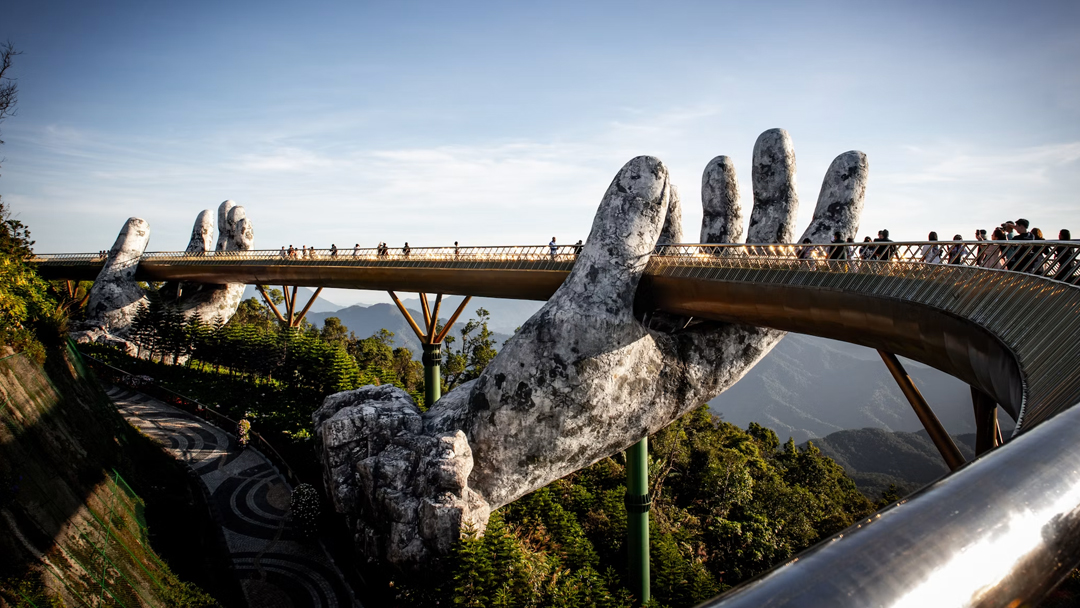
Ba Na Hills, about 25 miles inland, is a mountaintop resort area best known for the Golden Bridge, a pedestrian walkway held up by two enormous stone hands. Getting there involves a cable car ride that holds several Guinness World Records for length and height, offering views over jungle canopy and terraced hillsides along the way.
The complex above includes a French-village-themed area with a wine cellar, gardens, and a small amusement park. It’s a full-day outing given the travel time, and arriving early helps avoid the tour bus crowds that build up by midday.
Getting the Timing Right
The best stretch of weather runs from February through May, before the summer humidity and the typhoon season that typically peaks between September and November. A few days in Da Nang works best when spread across a mix of early mornings at the beach, one full day dedicated to Ba Na Hills or the Marble Mountains, and evenings left open for the Dragon Bridge and the night markets along the river. Building in that kind of flexibility matters more than packing every hour with sightseeing, since some of the best parts of the city show up in the unplanned gaps between destinations.